


The Complete Guide to How Your Pension System Works
A Pension is long-term savings built from monthly contributions, invested in the capital market, and converted into a monthly benefit at retirement age. On this page, we explain how the pension mechanism works, how the money grows over the years, who manages it, and which decisions are in your hands.
- Reading time
- 6 minutes
- Last updated
Pension savings are the primary mechanism designed to ensure you have a stable monthly income when you stop working. They are a financial marathon based on regular monthly contributions throughout your working years.
Contributions are made by you and your employer (or by you alone if you are self-employed) and managed by a professional pension provider.
How pension savings work in practice
The pension mechanism operates according to a simple formula:
- 1. Contribution
- Every month, contributions are deposited into Pension savings by you and your employer (or by you alone if you are self-employed).
- 2. Investment
- The money is not kept in a "safe"; rather, it is invested in the capital market (stocks, bondsA type of "loan" that an investor provides to a government or company in exchange for repayment of the principal plus interest., and real estate) to generate ReturnThe profit (or loss) from an investment over a certain period, usually expressed as a percentage of the original amount invested. over time.
- 3. Pension payment
- At retirement age, the savings are converted into a monthly pensionThe monthly amount paid to the saver in retirement, calculated by dividing the amount accumulated by a "conversion factor." intended to serve as your primary source of income.
Unlike regular savings, at retirement the money is not withdrawn as a lump sum but converted into a monthly pension paid to you (and sometimes also to survivors—spouses and children—according to the fund's rules) for life.
This is retirement-specific savings, with clear rules, strict regulation, and restrictions intended to ensure that the money serves as your primary source of income in old age.
How does your money grow?
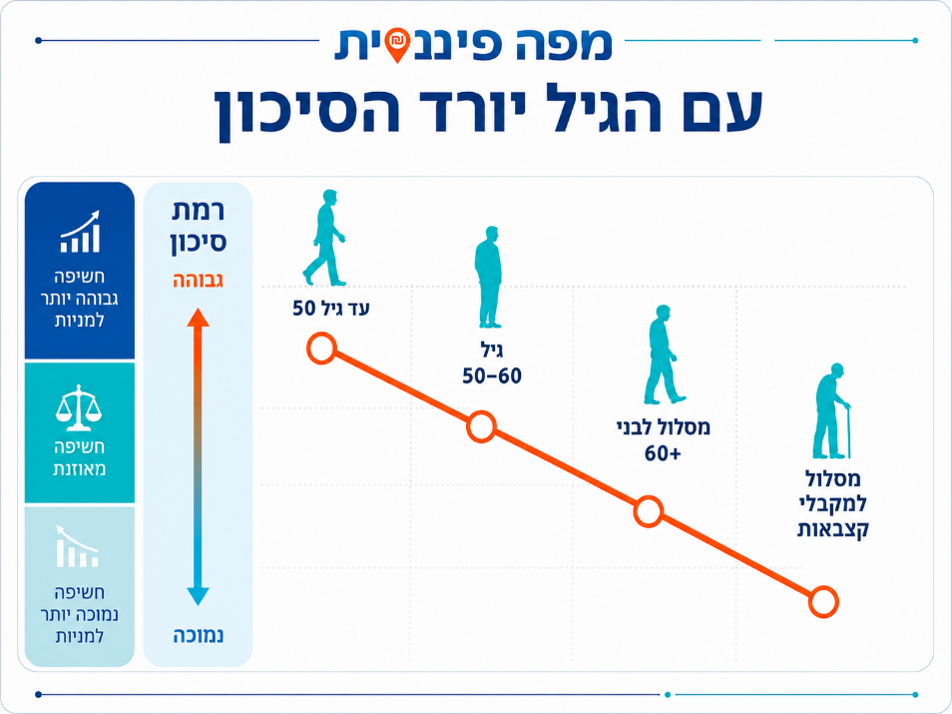
To ensure your savings grow and last for many years, your money does not "sit on the sidelines"; it is invested in the capital market (stocks, bonds, real estate, and more) to generate Return.
Two key mechanisms drive savings:

Who actually manages your Pension?
Understanding "who does what" will help you know whom to contact and make informed decisions.
- You (the decision-makers): The central party. Responsibility for choosing the managing provider and investment track is in your hands.
- The employer (for employees): Responsible for transferring the funds on time and setting the contribution percentages. It is important to remember: the employer is not responsible for the portfolio's performance or its suitability for your needs.
- Pension providers (Insurance companies and investment houses): Manage the investments in practice, charge management fees, and pay pension benefits and Insurance coverage.
- Regulator (Capital Market Authority): Sets the "rules of the game," supervises the providers, and protects savers' rights.
- Insurance agents and pension advisors: Mediate between you and pension providers, help select a product, investment track, and suitable Insurance coverage, and assist with changes along the way.
Insurance agent vs. pension advisor
| Feature | Insurance agent | Pension advisor |
|---|---|---|
| Affiliation with providers | Works with certain pension providers | Objective, with no affiliation with a specific provider |
| Compensation model | Commissions from the pension providers they work with | Direct payment from you or your employer |
| Considerations | May include commercial considerations | Completely neutral |
Frequently asked questions
What happens if I need the money tomorrow?
Withdrawing Tagmulim (תגמולים) funds before retirement age is considered an "unlawful withdrawal" and is subject to a tax of 35% of the amount. Pitzuyim (פיצויים) funds may be withdrawn when employment ends (subject to employer approval and tax rules).
However, withdrawal harms future Pension savings and may create a tax liability, so it should be considered only in cases of genuine need.
Who actually manages my money?
Insurance companies and investment houses manage the investments, while the Capital Market Authority (the Regulator) sets the rules and supervises them.
How can I find out how much money I have?
You can check this through the personal area on the managing body's website or through HaMislaka HaPensionit (המסלקה הפנסיונית), which consolidates all your savings into a single report.
Does my employer choose the fund for me?
Employees may choose their own Pension fund or any other pension product.
If you have not made a choice, your employer may enroll you in a default fund, but you can change this at any time.
Compare and choose wisely
Before choosing a Pension fund, review the table we created for you, based on Capital Market Authority data, and compare which funds delivered the highest Return with the lowest management fees.
In summary,
Your Pension is a puzzle made up of your decisions, employer contributions, management by investment companies, and state oversight. The better you understand the full picture, the better you can ensure that your money works for you in the best possible way.